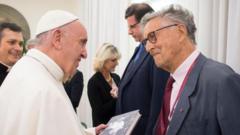
David Willey, the BBC's veteran Vatican correspondent who chronicled five pontificates across nearly four decades, has died at 93. Willey spent his career documenting the Catholic Church's evolution from the papacy of Paul VI through Benedict XVI, establishing himself as one of broadcasting's most authoritative voices on Vatican affairs and papal politics.
His tenure at the BBC spanned from the 1970s onward, making him one of the corporation's longest-serving foreign correspondents. Willey covered watershed moments in modern Catholic history: the Second Vatican Council's aftermath, John Paul II's transformative papacy and his role in Cold War politics, the sex abuse scandals that rocked the institution, and the unexpected resignation of Benedict XVI in 2013. His reporting provided British audiences with insider perspective on how the Church navigated doctrinal disputes, interfaith relations, and institutional crises.
Willey's longevity in the role reflected both his institutional knowledge and his standing among Vatican officials. Few journalists develop the deep sources and access he maintained across multiple generations of Church leadership. His work helped set the standard for Vatican reporting in the modern era, translating complex theological and ecclesiastical matters for general audiences without sacrificing nuance.
Beyond breaking news, Willey's reporting often examined the Church's influence on global affairs. He tracked papal diplomatic initiatives, documented the Church's positions on contraception and clerical celibacy, and reported extensively on abuse scandals and their institutional cover-ups. His voice became synonymous with Vatican affairs in British broadcasting.
The BBC confirmed his death, marking the end of an era in Vatican journalism. Few correspondents anywhere achieved Willey's depth of access or length of service in one posting. His departure removes a seasoned observer whose memory and relationships spanned decades of modern Catholic history.