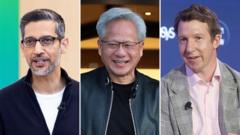
Tech leaders are redirecting young talent away from narrow technical specialization toward broader skill sets in the AI era. Sundar Pichai, CEO of Google and Alphabet, Jensen Huang, CEO of Nvidia, and Jack Clark, co-founder of Anthropic, told the BBC that students should prioritize liberal arts, humanities, and interdisciplinary learning alongside computer science.
Pichai emphasized that AI will handle routine coding tasks, making human creativity and critical thinking more valuable. He advocated for studying philosophy, economics, and social sciences to understand AI's societal implications. Huang pushed back against the traditional computer science pipeline, suggesting that aspiring engineers learn physics, mathematics, and domain expertise in fields like biology or climate science. Clark stressed domain knowledge, noting that AI's most impactful applications emerge from deep understanding of specific industries and problems, not just algorithmic prowess.
The advice signals a seismic shift in how Big Tech perceives talent pipelines. As generative AI commoditizes basic programming ability, companies recognize that competitive advantage hinges on people who can bridge technical and non-technical worlds. A software engineer fluent in business strategy, ethics, or scientific methodology becomes more valuable than one who merely writes code.
This reflects real labor market dynamics. Entry-level coding bootcamps have already seen declining enrollment. Meanwhile, companies struggle to find people who can articulate AI's risks, navigate regulatory frameworks, or apply machine learning to domain-specific problems. The AI gold rush now favors polymaths over specialists.
For students, the message is clear. Don't bet your career on languages and frameworks that'll be obsolete in five years. Build foundational reasoning skills, develop expertise in a non-tech field, and learn to ask better questions than any LLM can answer.