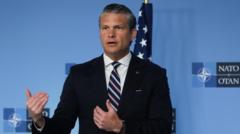
Pete Hegseth, confirmed as US Defense Secretary in January 2025, is escalating criticism of NATO while signaling a comprehensive review of American military presence across Europe. His comments follow the Trump administration's decision to reduce US commitments to NATO's high-readiness rapid reaction force, a strategic unit designed for quick deployment to alliance members facing security threats.
Hegseth's stance reflects broader administration skepticism toward NATO burden-sharing arrangements. The Defense Secretary has repeatedly argued that European allies underfund their own defense while relying on American military backing. This rhetoric aligns with Trump's longstanding position that NATO members should dramatically increase defense spending or face reduced US support.
The review of US troop deployments in Europe carries real consequences for alliance stability. America currently maintains roughly 80,000 military personnel across the continent, concentrated in Germany, Italy, and Poland. Any significant reduction would reshape NATO's eastern flank, where allies like Poland and the Baltics depend on US forward presence as deterrence against Russian aggression.
The scaling back of US commitments to NATO's rapid reaction force signals a shift away from the collective defense posture that has defined the alliance since Russia's 2022 invasion of Ukraine. European defense budgets have risen in response to that conflict, with many NATO members now meeting or exceeding the 2 percent GDP spending threshold. Yet Hegseth's comments suggest the administration views these efforts as insufficient.
This moment presents a test of NATO cohesion. While some allies view American skepticism as negotiating leverage to extract higher spending, others see it as a genuine threat to alliance unity. The outcome of Hegseth's review could determine whether NATO adapts to American demands or faces the most serious rupture in its 75-year history.