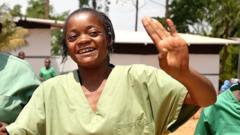
The BBC documented scenes of resilience and unexpected moments of joy in the Democratic Republic of Congo as the nation battles an Ebola outbreak that has claimed over 170 lives. The reporting captures the human dimension of a health crisis often defined solely by its mortality statistics.
Health workers and survivors in the DRC's affected regions continue their daily work despite the virus's spread. The outbreak, centered in the country's eastern regions, represents one of the deadliest Ebola cases in recent years. Yet the BBC's account reveals communities and medical teams finding brief moments of connection and hope within a devastating situation.
The epicenter of the outbreak has seen consistent international response, with organizations like the World Health Organization coordinating containment efforts. Vaccination campaigns and isolation protocols have become routine in affected areas, though access to healthcare remains uneven across the region.
The reporting underscores the psychological toll of Ebola outbreaks beyond physical casualties. Healthcare workers face burnout and isolation, yet many continue their work despite personal risk. Survivors undergo lengthy recovery processes, and communities grapple with loss and fear.
This narrative approach contrasts with typical crisis coverage that emphasizes body counts and worst-case scenarios. By documenting moments of human connection and determination, the BBC illustrates how affected populations maintain dignity and community bonds amid medical catastrophe. Such reporting acknowledges that epidemics unfold not in abstractions but through the lived experiences of real people navigating impossible circumstances.
The DRC's response continues with ongoing vaccination efforts and international support, while the broader public health community monitors the outbreak's trajectory closely.