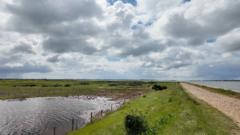
Hampshire's Lepe Country Park, a wetland designated as a Site of Special Scientific Interest and protected under international law, faces ecological collapse as coastal flood defences deteriorate at the reserve's edges. The aging barriers fail to contain seasonal flooding that now penetrates deeper into protected habitats each year.
The reserve, which spans over 600 acres along the Solent coast, supports breeding populations of migratory birds, rare invertebrates, and salt marsh vegetation found nowhere else in southern England. Repeated tidal breaches have accelerated soil erosion and saltwater intrusion into freshwater wetland zones, destroying nesting sites and disrupting food chains that depend on specific plant communities.
Local conservationists report that maintenance funding for the defences has stalled for over a decade. The Hampshire and Isle of Wight Wildlife Trust estimates restoration costs at £8 million, but local councils and the Environment Agency cite budget constraints amid broader climate adaptation pressures across England's coast.
The deterioration exemplifies a wider crisis. Over 40 percent of England's designated coastal nature reserves lack adequate flood protection, according to a recent parliamentary inquiry. Rising sea levels and increased storm surge intensity compound the problem, making traditional sea walls obsolete within 15 to 20 years.
Conservationists argue the reserve represents a test case for nature-based coastal defence. Rather than reinforcing concrete barriers, restoring natural salt marshes and mangrove-like vegetation could absorb storm energy while regenerating habitat. This approach costs less long-term than conventional engineering while sequestering carbon and supporting biodiversity.
Without intervention within the next two years, ecologists warn that Lepe will lose 30 percent of its current species diversity. The reserve's decline would reduce stopover habitat for Slavonian grebes and other migratory species traveling between Arctic breeding grounds and African wintering sites, cascading impacts across three continents.