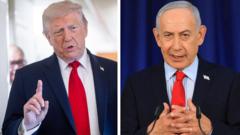
Donald Trump and Benjamin Netanyahu's approach to reshaping Middle Eastern geopolitics has backfired spectacularly, leaving both leaders grappling with a conflict spiral neither fully anticipated or can contain.
The two leaders pursued an aggressive strategy centered on confronting Iran and its regional proxies, betting they could force a realignment favorable to US and Israeli interests. That calculation proved catastrophically wrong. Instead of establishing dominance, their actions have triggered cascading instability across the region, with multiple actors now operating outside their control.
The miscalculation extended to underestimating Iran's willingness to respond directly to provocation. Rather than capitulating, Tehran escalated, launching ballistic missiles and expanding support for regional militias. This created a dynamic neither Washington nor Jerusalem could easily manage through conventional military means. The conflict with Hezbollah intensified beyond initial scope. Palestinian territories descended further into chaos. Regional powers like Saudi Arabia and the UAE found their own interests misaligned with the Trump-Netanyahu vision.
What emerged instead of regional reshaping is what analysts now describe as a "permacrisis." Multiple conflicts simmer simultaneously without clear resolution pathways. American military resources stretch thin across several theaters. Israeli security, paradoxically, appears less assured than before the strategy's implementation. Iran has solidified rather than weakened its regional position.
The cost of this miscalculation manifests in humanitarian terms, destabilized economies, and the entrenchment of hostile actors. Ordinary civilians across Iraq, Syria, Lebanon, Gaza, and beyond bear the consequences of decisions made in Washington and Jerusalem offices.
Both leaders face a political reckoning. Trump confronts questions about his Middle East judgment heading into negotiations. Netanyahu struggles domestically while managing a conflict without victory conditions. The region they sought to remake now resists easy solutions, potentially determining the trajectory of US foreign policy for years ahead.