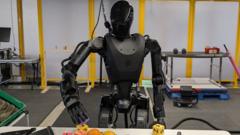
Military research labs worldwide are testing humanoid robots for combat roles, but operational deployment remains years away. The U.S. Department of Defense, along with armed forces in China, Russia, and Europe, have begun trials to assess whether bipedal machines can handle frontline tasks. Current experiments focus on reconnaissance, supply transport, and hazardous material handling rather than direct combat engagement.
The technical barriers are substantial. Humanoid robots struggle with terrain navigation, power consumption during extended missions, and real-time decision-making under fire. Battery life rarely exceeds eight hours of heavy use, and most current models move at speeds far slower than soldiers on foot. Communication latency between operators and machines introduces critical delays that could prove fatal in fast-moving tactical situations.
Boston Dynamics, the leading commercial robotics firm, has explicitly restricted its machines from weaponization in licensing agreements. However, smaller defense contractors and state-sponsored research programs operate without such restrictions. Russia and China have publicly announced intentions to integrate humanoid platforms into military doctrine within the next decade, though credible assessments suggest these timelines are optimistic.
Legal and ethical frameworks remain underdeveloped. The U.N. has raised concerns about autonomous lethal weapons systems, but no binding international agreement exists. The U.S. military maintains a policy requiring human control over weapons deployment, yet this standard faces pressure as competitors advance their capabilities.
Experts predict humanoid robots will first appear in support roles. Carrying ammunition, evacuating wounded soldiers, or managing supply lines in contested zones presents lower-risk applications. Direct combat deployment would require breakthroughs in artificial intelligence, durability, and cost reduction that likely remain five to ten years distant. Military analysts emphasize that humanoid platforms offer no inherent advantage over purpose-built quadrupedal or wheeled alternatives for most tactical needs, limiting their appeal despite the symbolic power of human-shaped machines.