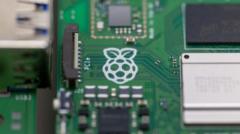
Raspberry Pi lifted its profit guidance for the first half of 2026, projecting adjusted earnings of at least $38 million. The British chipmaker attributes the upgraded forecast to surging demand for artificial intelligence applications.
The company manufactures low-cost single-board computers used in hobbyist projects, industrial automation, and edge computing. Raspberry Pi's shift reflects broader momentum in the AI hardware sector, where demand for processors and computing devices has accelerated across sectors. The forecast increase signals confidence in sustained AI adoption and the company's ability to capture market share in this expanding category.
Raspberry Pi's raised guidance comes as AI infrastructure spending accelerates globally. The company positions itself at an accessible price point for developers and businesses integrating AI into smaller-scale applications and edge devices. These computers power machine learning inference, IoT deployments, and robotics projects where full-scale data centers prove unnecessary or inefficient.
The £28.2 million earnings projection marks a notable performance expectation for a company known for affordable computing hardware. Raspberry Pi's public listing earlier gave investors direct exposure to the AI boom filtering into hardware manufacturing. The profit increase reflects both volume growth and potentially improved margins as manufacturing scales.
The forecast demonstrates how AI demand ripples beyond cloud infrastructure into specialized hardware. Raspberry Pi capitalizes on developers and enterprises seeking cost-effective computing power for localized AI workloads. As organizations deploy machine learning models at the edge, small-form-factor computers gain relevance in production systems beyond traditional maker communities.
This guidance update underscores investor appetite for companies positioned across the AI value chain, particularly those offering accessible entry points for widespread adoption.