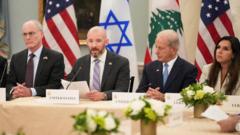
Israel and Lebanon have agreed to implement a ceasefire contingent on Hezbollah ceasing attacks against Israeli territory, according to a statement from the US State Department. Both countries have committed to rejecting "any attempt, by any state or non-state actor, to hold Lebanon's future hostage."
The agreement marks a potential de-escalation in the region after months of escalating tensions between Israel and the Iran-backed militant group. The ceasefire framework requires Hezbollah, which operates primarily from southern Lebanon, to halt cross-border attacks that have targeted Israeli communities and military positions.
The US State Department emphasized the conditional nature of the arrangement, making clear that implementation depends entirely on Hezbollah's compliance. The language about rejecting attempts to "hold Lebanon's future hostage" signals concerns that external actors, particularly Iran and its allied forces, could undermine any peace agreement.
Hezbollah has not yet publicly confirmed its acceptance of the terms, creating uncertainty about whether the group will abide by the ceasefire conditions. The organization maintains significant military and political influence within Lebanon and has historically resisted pressure from international actors.
Israel has maintained that security along its northern border remains a top priority after Hezbollah's cross-border rocket attacks prompted Israeli military responses and air strikes. Lebanese officials have expressed concerns about civilian casualties and infrastructure damage from Israeli operations.
The agreement reflects ongoing diplomatic efforts to contain the conflict and prevent further regional escalation. International mediators, including the United States, have pushed for a resolution that allows both countries to step back from military confrontation. Whether Hezbollah honors the ceasefire conditions will determine if the arrangement holds or if hostilities resume.