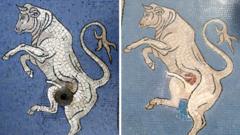
Milan's restoration of a centuries-old bull mosaic sparked unexpected controversy when conservators removed the animal's testicles during cleanup work. The 16th-century tile mosaic, located in the Sforza Castle, depicts a charging bull and has long held symbolic significance in Milanese culture. The testicles, rendered in distinctive tile work, reportedly functioned as a good-luck charm for visitors who touched them during passages through the castle.
Social media erupted with confusion and mild outrage as word spread that the restoration team had eliminated the anatomical feature entirely. Locals expressed bewilderment over the decision, with many viewing the removal as a loss of cultural tradition rather than a necessary conservation measure. The bull mosaic had become a touchstone for generations of Milaneses who rubbed the testicles for prosperity and fortune, much like other fertility symbols across European heritage sites.
Restoration officials clarified that the removal aimed to preserve the mosaic's structural integrity and prevent further degradation caused by constant handling. The testicles, which had suffered significant wear from centuries of contact, posed conservation challenges. Experts determined that restoring them would require modern intervention that contradicted traditional restoration principles prioritizing original materials.
The incident reflects broader tensions between preservation standards and public interaction with cultural artifacts. While the restoration preserves the mosaic's overall aesthetic and historical value, it erased a tactile, participatory element that connected modern Italians to their architectural heritage. The bull remains in the castle, but visitors now encounter a mathematically and artistically complete restoration minus the folk tradition that made it memorable.