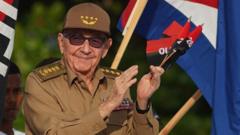
The U.S. Department of Justice indicted former Cuban leader Raúl Castro for his role in the 1996 downing of two civilian aircraft off the coast of Florida, marking the first time Washington has formally charged the aging politician with murder and conspiracy to kill American nationals.
The indictment alleges Castro ordered the military shootdown of two Cessna planes operated by Brothers to the Rescue, a Miami-based organization that conducted search-and-rescue missions for Cuban defectors. The attack killed four people, all U.S. citizens. Castro and co-defendants face charges including conspiracy, destruction of aircraft, and intentional killing of U.S. nationals.
Cuban President Miguel Díaz-Canel immediately rejected the charges as a "political manoeuvre" devoid of legal foundation. The Cuban government has consistently defended the 1996 incident as a legitimate military response to what it characterized as aerial intrusions into its airspace.
The timing of the indictment carries geopolitical weight. Raúl Castro, now 93, stepped down from Cuba's presidency in 2021 but remained influential within the Communist Party until recently. The U.S. has maintained economic sanctions against Cuba for decades. This prosecution signals Washington's willingness to pursue decades-old cases tied to Cold War-era tensions.
Extradition appears unlikely given the absence of diplomatic relations and Cuba's refusal to surrender nationals for prosecution abroad. The indictment functions partly as a symbolic statement about U.S. commitment to accountability for actions against American citizens, even when practical enforcement remains distant.
The 1996 incident remains one of the most contentious episodes in U.S.-Cuba relations, representing a flashpoint between Havana's sovereignty claims and Washington's protection of its citizens abroad.