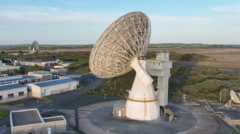
A Texas-based satellite communications firm is acquiring a deep space station in a £37 million deal that expands its network for interplanetary missions. The purchase strengthens the company's footprint in spacecraft tracking and data relay operations, critical infrastructure for NASA missions and private space ventures.
Deep space communications stations operate as ground-based relay points for spacecraft traveling beyond Earth orbit. These facilities receive telemetry data and transmit commands to probes exploring Mars, the outer planets, and deep space. Only a handful of these stations exist globally, making each acquisition strategically significant for companies operating in the space industry.
The unnamed Texas firm joins a consolidating market where private operators increasingly support government space agencies. NASA traditionally maintained its own Deep Space Network, a three-station system, but now partners with commercial providers to handle growing data volume from multiple simultaneous missions. Private companies like Axiom Space and SpaceX have accelerated this shift toward commercialized space infrastructure.
The £37 million valuation reflects the station's specialized equipment and location advantages. Deep space stations require enormous antenna arrays, sensitive receivers capable of detecting faint signals from spacecraft millions of miles away, and redundant systems for mission-critical reliability. Real estate matters too. Geographic distribution across continents ensures continuous communication windows as Earth rotates.
The deal positions the Texas company to capture contracts from space agencies and commercial operators launching probes to the Moon, Mars, and beyond. With multiple exploration programs ramping up, demand for ground station capacity has intensified. The European Space Agency, JAXA, ISRO, and commercial entities all need tracking infrastructure.
This acquisition reflects broader industry confidence in sustained deep space activity. The next decade promises increased lunar missions, Mars sample return operations, and potential crewed missions to deep space, all requiring reliable communication networks.