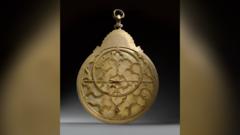
A rare 17th-century astrolabe from Indian royal collections sold at auction for a record price, marking a significant moment for the historical scientific instrument market. The brass astronomical device, possibly the largest astrolabe in existence, emerged from private ownership for the first time in its documented history.
Astrolabes functioned as the era's most sophisticated computational tools, enabling astronomers and navigators to map celestial movements, determine latitude, and solve complex mathematical problems. Created centuries before the electronic computer, these instruments represented the pinnacle of pre-modern scientific engineering. The Indian royal provenance elevated this particular example's historical value, connecting it to centuries of astronomical study across South Asian courts.
The astrolabe's record sale reflects growing collector appetite for rare scientific artifacts and instruments that predate industrialization. Museums and private buyers increasingly recognize these pieces as windows into pre-modern technological achievement and cross-cultural knowledge exchange. The fact that this specimen remained unseen by the public until auction underscores how many historically important objects remain hidden in private collections.
The instrument's size distinguishes it from typical astrolabes, many of which were portable pocket devices. Larger versions served educational and ceremonial purposes in astronomical institutions. Its journey from Indian nobility to the international auction block illustrates the complex pathways through which cultural heritage circulates in today's art and antiquities markets.
This sale arrives as interest in non-Western scientific history gains momentum. Scholars increasingly spotlight how Indian, Persian, and Arab astronomers developed sophisticated mathematical and observational systems that rivaled or exceeded European contemporaries. Objects like this astrolabe ground those academic conversations in tangible evidence of technological mastery.
THE BOTTOM LINE: A previously unknown 17th-century astrolabe from Indian royal collections achieved a record auction price, highlighting renewed collector interest in pre-modern scientific instruments and non-European astronomical history.